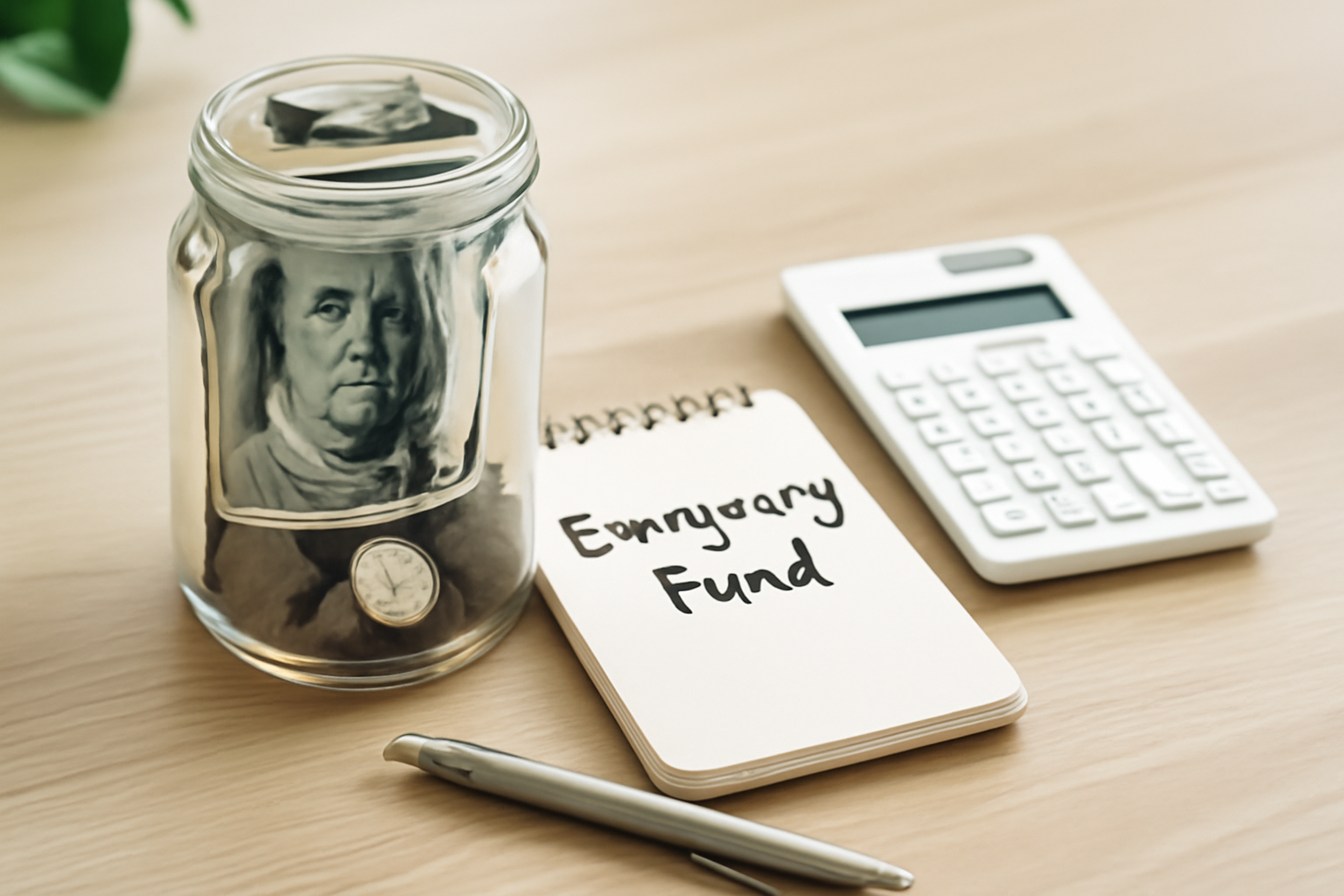
Emergency Fund: How to Build One That Actually Works
Learn how to save 3 to 6 months of expenses — and why having the right amount in the right place can protect everything else you’ve built.
Introduction
Nearly 57% of Americans can’t cover an unexpected $1,000 expense without going into debt, according to Bankrate’s 2025 Emergency Savings Report. That’s not a fringe statistic — it represents more than half the country one bad day away from a financial crisis.
A job loss, a medical bill, a busted transmission — any of these can derail years of careful budgeting if you don’t have a financial cushion in place. That cushion is your emergency fund, and it’s arguably the single most important foundation of any personal finance plan.
In this guide, you’ll learn exactly how an emergency fund works, how much you actually need, where to keep it, and how to build one even if you’re living paycheck to paycheck right now. By the end, you’ll have a clear, step-by-step plan you can start this week.
This is for educational purposes — consult a licensed financial advisor for personalized guidance.
What Is an Emergency Fund and How Does It Work?
An emergency fund is a dedicated pool of cash set aside exclusively for unplanned, necessary expenses. It’s not a vacation fund, a down payment fund, or an investment account. It exists for one reason: to absorb financial shocks without sending you into debt.
Think of it as your financial immune system. When something goes wrong — and at some point, something will — your emergency fund absorbs the hit so your credit cards, retirement accounts, and long-term savings don’t have to.
According to the Federal Reserve’s 2024 Report on the Economic Well-Being of U.S. Households, roughly 37% of adults said they would have difficulty handling an unexpected $400 expense. That number has improved in recent years, but it still reveals a massive vulnerability in American household finances.
An emergency fund works by keeping liquid, accessible cash completely separate from your spending money. It’s not invested in the stock market. It doesn’t have a lock-up period. You can access it within one to two business days when you need it most.
The key distinction: it must be for genuine emergencies. A surprise car repair — yes. A sale on flights to Miami — no.
Key Benefits: Why an Emergency Fund Changes Everything
An emergency fund isn’t just about having cash available. It fundamentally changes how you make financial decisions — and not just in a crisis.
1. You avoid high-interest debt spirals. The average APR on a credit card in 2026 hovers around 21%, according to the Federal Reserve. Without an emergency fund, a $3,000 car repair goes on a credit card — and at 21% interest, that bill can balloon quickly if you’re only making minimum payments.
2. You protect your retirement savings. Many Americans raid their 401(k) when emergencies hit. In most cases, an early withdrawal before age 59½ triggers a 10% IRS penalty on top of ordinary income taxes. A $10,000 401(k) withdrawal could cost you $3,500 or more in penalties and taxes alone — not counting the lost future growth.
3. You make better career decisions. When you have three to six months of expenses saved, you have the freedom to leave a toxic job, negotiate a raise, or take time to find the right opportunity instead of accepting the first offer out of desperation.
4. You reduce financial stress measurably. A 2023 study from the American Psychological Association found that financial stress is the leading cause of anxiety in American households. A fully funded emergency fund won’t eliminate money worries entirely, but it creates real psychological breathing room.
Simply put: an emergency fund makes every other financial goal — investing, debt payoff, buying a home — significantly more achievable.
How to Build Your Emergency Fund: Step-by-Step
Building an emergency fund when money is already tight feels impossible. But the strategy isn’t to save everything at once — it’s to build momentum one small step at a time.
Step 1: Calculate your target number. The standard rule is 3 to 6 months of essential living expenses — not income. Add up your rent or mortgage, utilities, groceries, insurance, minimum debt payments, and transportation. If that total is $3,500/month, your target range is $10,500 to $21,000.
Generally speaking, aim for 6 months if you’re self-employed, have an irregular income, or work in a volatile industry. Three months may be sufficient if you have a stable government or corporate job with strong benefits.
Step 2: Start with a $1,000 starter fund. Before you hit your full target, build a $1,000 buffer first. This covers the most common unexpected expenses — a car repair, a medical copay, a home appliance failure — and protects you from reaching for a credit card in the meantime.
Step 3: Open a dedicated high-yield savings account (HYSA). Keep your emergency fund completely separate from your checking account. In 2026, many online banks and credit unions offer HYSAs with APYs ranging from 4.5% to 5.2%. Your money earns interest while it waits — and it’s not tempting you every time you log into your bank app. Look for accounts that are FDIC-insured up to $250,000.
Step 4: Automate your contributions. Set up an automatic transfer from your checking account to your HYSA on payday — even if it’s just $50 or $100. Automation removes the decision from the equation. You save before you spend.
Step 5: Accelerate with windfalls. Every time you receive a tax refund (the average federal refund in 2025 was $3,167 according to the IRS), a bonus, or a cash gift, direct a meaningful percentage — 50% is a strong target — straight to your emergency fund.
Step 6: Define what counts as an emergency — in writing. Before you need the money, write down your rules. Qualifying expenses might include: job loss, medical emergencies, essential car repairs, or urgent home repairs. Non-qualifying: vacations, holiday shopping, non-urgent purchases. Having this written down prevents rationalization in the moment.
Costs, Fees, and Risks to Watch For
An emergency fund isn’t complicated, but there are real risks in how you manage it.
Opportunity cost: Cash sitting in a savings account — even a high-yield one — will generally underperform the stock market over a long time horizon. The S&P 500 has historically returned an average of around 10% annually before inflation, while a HYSA currently earns 4-5%. That gap is the price of liquidity and safety. For an emergency fund, it’s a cost worth paying.
Inflation erosion: If inflation runs at 3-4% and your HYSA earns 4.5%, your real return is slim. But the purpose of an emergency fund isn’t to grow wealth — it’s to preserve purchasing power and provide access. Don’t move it into volatile assets chasing higher returns.
Tax implications: Interest earned in a high-yield savings account is taxable as ordinary income. If your HYSA earns $800 in interest over the year, that amount is reported on a 1099-INT form and taxed at your marginal rate. It’s a minor consideration, but factor it into your planning.
Account fees: Some savings accounts charge monthly maintenance fees, minimum balance fees, or excessive transaction fees. Always read the fine print. Most reputable online banks offer fee-free HYSAs with no minimum balance requirements.
Under-saving risk: The biggest financial risk is not having enough. Many Americans estimate their emergency fund target too low because they undercount true monthly expenses — especially insurance premiums, subscriptions, and healthcare costs. Recalculate every 12 months.
Common Mistakes to Avoid
Even financially savvy people make these errors when building or managing their emergency fund.
Mistake #1: Keeping it in your regular checking account. If your emergency fund lives in the same account you use for daily spending, it will get spent — slowly, without you even noticing. The psychological separation of a dedicated account matters. Set it up at a different bank if necessary.
Mistake #2: Investing it in the stock market. Some people, wanting to maximize returns, put their emergency fund into index funds or ETFs. This is dangerous. If the market drops 30% right when you lose your job, your emergency fund is suddenly worth 30% less at the worst possible time. Emergency funds must stay liquid and stable.
Mistake #3: Not replenishing after using it. Using your emergency fund is exactly what it’s for — but many people use it and then treat rebuilding as optional. After a withdrawal, immediately restart automatic contributions until the fund is fully restored. Your financial immune system needs to be back at full strength before the next crisis hits.
Mistake #4: Setting the wrong target. A single person with a stable remote job and no dependents has a very different risk profile than a self-employed parent of three with a mortgage. Don’t copy someone else’s target. Calculate yours based on your specific monthly expenses and job stability.
Mistake #5: Waiting until you’re debt-free to start. Many people delay building an emergency fund because they’re focused on paying off debt first. This is understandable but risky. Without any cushion, one unexpected expense sends you straight back into debt. Build your $1,000 starter fund even while paying down debt.
Alternatives to Consider
An emergency fund is the gold standard, but depending on your situation, you might supplement it with one of these tools — never replace it entirely.
1. Home Equity Line of Credit (HELOC): If you’re a homeowner with substantial equity, a HELOC gives you access to a revolving line of credit at relatively low interest rates compared to credit cards. It can serve as a backup emergency resource. However, HELOCs require home equity, take time to set up, and your home is collateral — meaning you could lose it if you can’t repay. It’s a supplement, not a substitute. Learn more about how leveraging home equity fits into a broader financial plan.
2. Roth IRA contributions (not earnings): Your Roth IRA contributions — not the investment earnings — can be withdrawn at any time, tax-free and penalty-free. Some financial planners view this as a last-resort emergency option. However, withdrawing retirement contributions permanently reduces your long-term compounding growth. Use this only as a true last resort, and only after consulting a financial advisor. If you haven’t chosen between account types yet, our guide on Roth IRA vs. Traditional IRA can help you decide which fits your situation.
3. 0% APR credit cards: Some balance transfer or introductory-offer credit cards offer 0% APR for 12 to 21 months. In a pinch, this could bridge an emergency without immediate interest. But it requires excellent credit to qualify, and if you don’t pay it off before the promotional period ends, you could face deferred interest charges. Our breakdown of balance transfer credit cards walks through how to use these strategically without falling into the trap.
None of these alternatives provides the simplicity, reliability, and zero-risk profile of a properly funded emergency savings account. They’re backup plans — not the plan itself.
Frequently Asked Questions
How much should I have in my emergency fund?
Most financial experts recommend 3 to 6 months of essential living expenses. Calculate your actual monthly needs — rent, utilities, groceries, insurance, and minimum debt payments — and multiply by 3 or 6 depending on your job stability and income structure. Self-employed individuals should aim for 6 to 9 months.
Where is the best place to keep an emergency fund?
A high-yield savings account (HYSA) at an FDIC-insured bank is generally the best option. In 2026, competitive rates range from 4.5% to 5.2% APY. Look for no monthly fees, no minimum balance requirements, and fast transfer times to your checking account. Money market accounts are another solid option.
Should I build an emergency fund before paying off debt?
Generally speaking, yes — at least a starter fund of $1,000. Without any cushion, an unexpected expense can undo your debt payoff progress instantly. Once you have a $1,000 buffer, focus aggressively on high-interest debt before completing your full emergency fund.
Is a $1,000 emergency fund enough?
For a starter fund, $1,000 covers the most common small emergencies. But it’s not a complete emergency fund — it’s a first step. Continue building toward your 3-to-6-month target. A $1,000 fund won’t cover a job loss or a major medical event.
What qualifies as a real financial emergency?
Genuine emergencies include: unexpected job loss, urgent medical or dental expenses, essential car repairs needed to get to work, and critical home repairs (like a broken furnace or roof leak). Non-emergencies: vacations, holiday gifts, clothing sales, or planned expenses you forgot to budget for.
Conclusion
An emergency fund isn’t the most exciting part of personal finance — but it might be the most important. Without it, every financial goal you have is one bad month away from unraveling.
Start where you are. If $1,000 feels out of reach, start with $25 per paycheck and automate it. Open a dedicated high-yield savings account today, set an automatic transfer, and define your rules for what counts as an emergency before you need to make that call under pressure.
Once your emergency fund is fully funded, you can invest with more confidence, take on calculated risks, and build real long-term wealth — knowing that a financial shock won’t knock everything down.
Your next step: calculate your monthly essential expenses, multiply by three, and open a dedicated HYSA this week. That’s your target. Now go build it.
Financial Disclaimer: This article is for educational purposes only and does not constitute financial, tax, or investment advice. Always consult a licensed financial advisor, CPA, or attorney before making financial decisions.
Leave a Reply