What Is Dollar-Cost Averaging and How Does It Work?
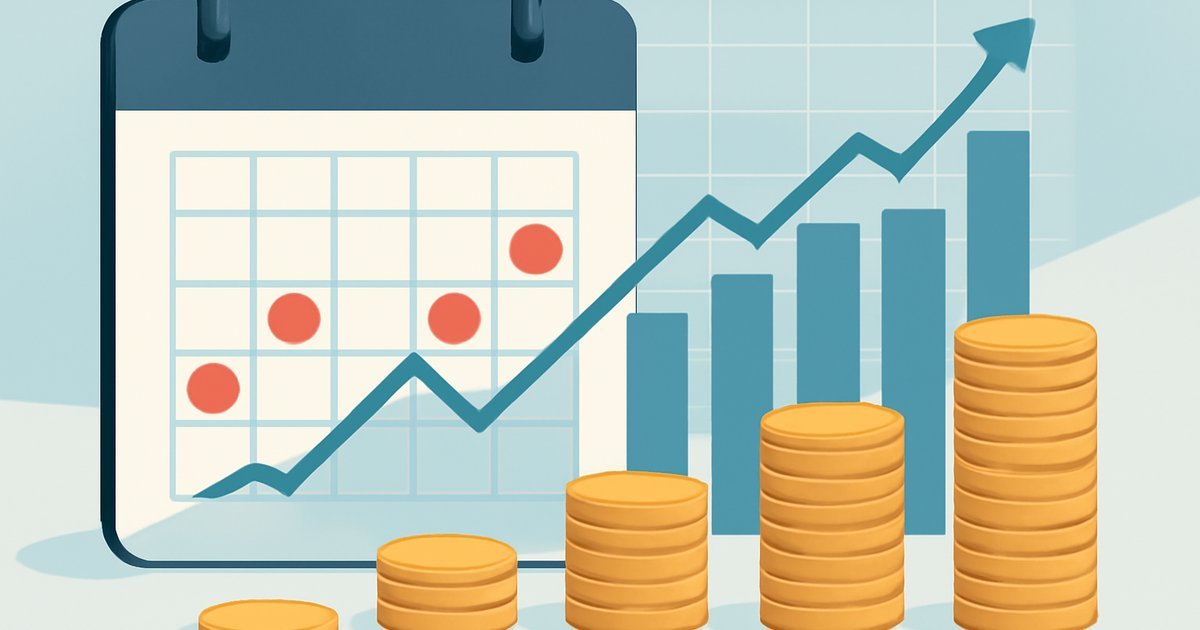
Dollar-cost averaging (DCA) is an investment strategy where you invest a fixed dollar amount at regular intervals — weekly, biweekly, or monthly — regardless of what the market is doing. Instead of trying to time the market perfectly, you buy consistently over time.
Here’s how it plays out in practice: suppose you invest $300 every month into an S&P 500 index fund. Some months, the fund is up and your $300 buys fewer shares. Other months, the market dips and your $300 stretches further, buying more shares at a lower price. Over time, your average cost per share tends to smooth out — reducing the risk of making one large investment right before a downturn.
This strategy applies to virtually any investor who contributes regularly to a 401(k), Roth IRA, or taxable brokerage account. If you’ve ever had money automatically deducted from your paycheck into a retirement plan, you’ve already been using dollar-cost averaging — you just may not have known it by name.
The core idea is simple: consistency beats timing. According to research from Vanguard, trying to time the market successfully over long periods is extremely difficult even for professional investors, making DCA a practical and psychologically sound alternative for most working Americans.
Key Benefits of Dollar-Cost Averaging
According to a 2024 Gallup survey, nearly 61% of Americans report owning stock — but a far smaller percentage invest with any kind of systematic strategy. Dollar-cost averaging offers several concrete advantages that make it especially well-suited for the average investor.
1. Reduces Emotional Decision-Making
Market volatility triggers fear. When the S&P 500 dropped roughly 25% in 2022, many investors panic-sold at a loss. DCA removes the emotional element by automating your investment schedule. You invest the same amount on the same date, no matter what the headlines say.
2. Lowers Your Average Cost Per Share
Because you buy more shares when prices are low and fewer when prices are high, your average cost per share can end up lower than if you had invested a lump sum at a single, potentially unfavorable price point. This is the mathematical core of the strategy.
3. Accessible on Any Budget
You don’t need $50,000 to get started. Many brokerage platforms — including Fidelity and Charles Schwab — now offer fractional shares and zero-minimum accounts, meaning you can start DCA with as little as $25 or $50 a month. This democratizes investing for people who are still building their income.
4. Builds Long-Term Wealth Through Compounding
When you invest $300 a month at an average annual return of 7% (a historically reasonable long-term estimate for diversified stock portfolios, though not guaranteed), you’d have approximately $180,000 after 25 years. The combination of regular contributions and compounding interest is a powerful wealth-building engine over time.
5. Works in Up and Down Markets
Unlike lump-sum investing, which is most effective when markets are trending upward immediately after your investment, DCA performs well across different market environments. It doesn’t require you to predict market direction — which is something very few investors do successfully.
How to Get Started with Dollar-Cost Averaging: Step-by-Step
Setting up a DCA strategy is straightforward. Here’s a practical roadmap tailored for U.S. investors in their 30s through 60s.
- Define your monthly investment amount. Start with what you can afford to invest consistently without disrupting your budget. Even $100 a month is a meaningful start. The key is sustainability — choose an amount you won’t need to stop contributing during a tough month.
- Choose an account type. If you have access to a 401(k) through your employer, maximize that first — especially if your employer matches contributions (that’s an immediate 50–100% return on part of your investment). Next, consider a Roth IRA (2026 contribution limit: $7,000, or $8,000 if you’re 50 or older). For additional investing beyond tax-advantaged accounts, a taxable brokerage account works well.
- Select your investment vehicle. For most DCA investors, low-cost index funds or ETFs that track broad market indices — like the S&P 500 or total stock market — are the most efficient vehicles. They offer instant diversification and typically have expense ratios under 0.10%.
- Set up automatic contributions. Log in to your brokerage or retirement plan and schedule recurring automatic transfers on your preferred date. Automating removes the willpower element entirely — you never have to decide whether to invest each month.
- Stay the course during downturns. This is where most DCA investors struggle. When the market drops 15%, resist the urge to pause contributions. A market dip is actually an opportunity — your fixed dollar amount buys more shares at lower prices. Historically, U.S. markets have recovered from every downturn, though past performance does not guarantee future results.
- Review annually, not daily. Check your portfolio allocation once or twice a year to ensure it still aligns with your risk tolerance and timeline. Rebalance if one asset class has grown significantly out of proportion. But avoid checking your balance every day — it leads to emotional decisions.
Costs, Fees, and Risks You Should Know
Dollar-cost averaging is low-cost by design, but there are still real risks and expenses to factor in before you commit.
Transaction Fees
Most major U.S. brokerages — Fidelity, Schwab, Vanguard, and others — now offer commission-free stock and ETF trades. However, some mutual funds may still carry transaction fees or sales loads. Always verify the fee structure before selecting your investment vehicle.
Expense Ratios
Even a small difference in fund fees compounds significantly over time. A fund with a 1% expense ratio costs you 10 times more annually than one with 0.10%. Over 30 years, that difference can add up to tens of thousands of dollars in lost returns. Always compare expense ratios before investing.
Tax Implications in Taxable Accounts
In a taxable brokerage account, each purchase creates a separate tax lot. When you eventually sell, the IRS requires you to track your cost basis for each purchase. This can become administratively complex over time. Tax-advantaged accounts like 401(k)s and IRAs avoid this issue since gains aren’t taxed until withdrawal (or not at all, in the case of Roth accounts).
Market Risk Still Exists
DCA does not eliminate market risk. If you invest regularly into a declining asset class over a long period and that asset never recovers, you will still lose money. Diversification across asset classes — stocks, bonds, and potentially real estate via REITs — helps manage this risk, but no strategy is entirely risk-free.
Opportunity Cost vs. Lump-Sum Investing
Research from Vanguard found that lump-sum investing outperforms DCA approximately two-thirds of the time in rising markets. This makes sense mathematically — money invested earlier has more time to compound. However, DCA remains the superior choice for investors who don’t have a large lump sum available, or who would otherwise let fear keep them on the sidelines entirely.
Common Dollar-Cost Averaging Mistakes to Avoid
Even a straightforward strategy like DCA can go wrong when investors make predictable errors. Here are the most costly ones to watch out for.
Mistake 1: Stopping Contributions During Market Crashes
The most damaging thing you can do to a DCA strategy is pause your contributions exactly when the market drops. This eliminates the core advantage of the strategy — buying more shares at lower prices. In March 2020, when the market fell roughly 34% in weeks, investors who stopped their DCA contributions missed one of the most powerful recovery rallies in U.S. market history. Stay the course.
Mistake 2: Choosing High-Fee Funds
Investing $300 a month consistently for 30 years is impressive. But if you’re doing it inside a mutual fund with a 1.5% annual expense ratio instead of a 0.03% index fund, the fee difference alone could cost you upward of $100,000 over your investing lifetime. Always check the expense ratio before hitting "buy."
Mistake 3: Not Taking Advantage of Tax-Advantaged Accounts First
Many investors open a standard taxable brokerage account before maximizing their 401(k) match or Roth IRA. That’s leaving free money and tax benefits on the table. In 2026, you can contribute up to $23,500 to a 401(k) (or $31,000 if you’re 50 or older). Prioritize these accounts before investing in taxable accounts. For more on maximizing retirement accounts, our guide on Roth IRA conversion strategy is a useful starting point.
Mistake 4: Investing in a Single Stock Instead of Diversified Funds
DCA works best when applied to diversified, broad-market investments. Applying it to a single company’s stock concentrates your risk significantly — if that company underperforms or goes bankrupt, your entire DCA portfolio suffers. Stick to diversified index funds or ETFs as your primary DCA vehicle.
Mistake 5: Ignoring Inflation on Fixed Contribution Amounts
If you set a $200/month contribution in 2015 and never adjusted it, you’re effectively investing less in real terms by 2026 due to inflation. As your income grows, revisit your contribution amount annually and increase it proportionally. Even a $25 or $50 monthly increase each year compounds into significantly higher returns over time.
Alternatives to Dollar-Cost Averaging
DCA is not the only way to invest systematically. Depending on your financial situation, one of these alternatives may be a better fit — or a useful complement.
1. Lump-Sum Investing
Best for: Investors who receive a windfall (inheritance, bonus, or 401(k) rollover) and have a long time horizon.
Pros: Historically outperforms DCA in rising markets; maximizes time in the market.
Cons: Requires strong emotional discipline during immediate volatility; poor timing can result in short-term paper losses. If you’re considering a large rollover, review how it fits with your broader financial plan before acting.
2. Value Averaging
Best for: More sophisticated investors who want to be more aggressive during downturns.
Pros: Adjusts your contributions based on portfolio performance — you invest more when the market drops and less when it rises, potentially outperforming standard DCA.
Cons: Requires more active management, discipline, and liquidity. You may need to contribute substantially more during downturns than your budget allows.
3. Target-Date Funds with Automatic Contributions
Best for: Investors who want a completely hands-off approach, especially within a 401(k).
Pros: Automatically adjusts asset allocation as you approach retirement; built-in diversification.
Cons: Typically carry slightly higher expense ratios than individual index funds; less flexibility in asset allocation control. Still, for many investors — particularly those who find investing overwhelming — these funds combined with automatic contributions represent an effective DCA approach by default.
Frequently Asked Questions About Dollar-Cost Averaging
Is dollar-cost averaging better than lump-sum investing?
It depends on your situation. Research from Vanguard shows lump-sum investing outperforms DCA about two-thirds of the time in historically rising markets. However, DCA is the better choice if you don’t have a large lump sum, if you’re investing monthly from your paycheck, or if market volatility would cause you to panic-sell after a large one-time investment. The best strategy is one you’ll actually stick to.
What is a good amount to start with for DCA?
There’s no universal right answer, but $100 to $500 per month is a realistic range for most working professionals. What matters more than the dollar amount is consistency. Start with what you can sustain without financial stress, then increase the amount as your income grows. Many brokerage platforms allow automatic investments with no minimum.
Can I use DCA inside a Roth IRA?
Absolutely — and it’s one of the most tax-efficient ways to apply DCA. You contribute after-tax dollars, your investments grow tax-free, and qualified withdrawals in retirement are also tax-free. The 2026 Roth IRA contribution limit is $7,000 (or $8,000 if you’re 50 or older), subject to income limits set by the IRS.
Does dollar-cost averaging work in a bear market?
Yes — and it arguably works best in bear markets. When asset prices fall, your fixed monthly contribution buys more shares. If the market eventually recovers (as U.S. markets have historically done over long periods), those extra shares purchased at lower prices contribute significantly to your long-term gains. The critical requirement is that you must continue investing during the downturn rather than stopping out of fear.
How do I track my average cost per share with DCA?
Most brokerage platforms automatically track your average cost basis across all purchases. You can view this in your account’s portfolio section. For tax purposes in taxable accounts, you can also choose a cost-basis accounting method — such as FIFO (first in, first out) or specific identification — which your broker will apply when you sell shares. Consult a CPA if you’re unsure which method is most tax-efficient for your situation.
Final Takeaways: Is Dollar-Cost Averaging Right for You?
Dollar-cost averaging won’t make you rich overnight, and it doesn’t eliminate market risk. What it does is give you a disciplined, accessible, and emotionally sustainable framework for building wealth over time — one that works whether you’re just starting out in your 30s or adding to an established portfolio in your 50s and 60s.
The most powerful thing about DCA isn’t the math — it’s the habit. Investors who contribute consistently, avoid panic-selling, and keep their fees low tend to build significantly more wealth over time than those who try to outsmart the market with perfect timing.
If you’re already contributing to a 401(k) or Roth IRA, you’re already doing it. If you’re not, today is a reasonable time to start — whether that means opening a brokerage account, setting up automatic contributions, or simply increasing what you’re already putting in each month.
Take one concrete next step this week: calculate what you can comfortably invest each month, open or log in to your investment account, and set up an automatic recurring contribution. Small, consistent actions compound into meaningful financial outcomes over time.
This article is for educational purposes only and does not constitute financial, tax, or investment advice. Always consult a licensed financial advisor, CPA, or attorney before making financial decisions.