What Is Asset Allocation and Why Does It Define Your Financial Future?
According to a landmark study by Brinson, Hood, and Beebower — widely cited by Vanguard and Morningstar — asset allocation explains more than 90% of the variation in a portfolio’s long-term returns. Yet most investors spend the majority of their time trying to pick individual stocks, chasing the next hot fund, or timing the market.
That’s the wrong game to play.
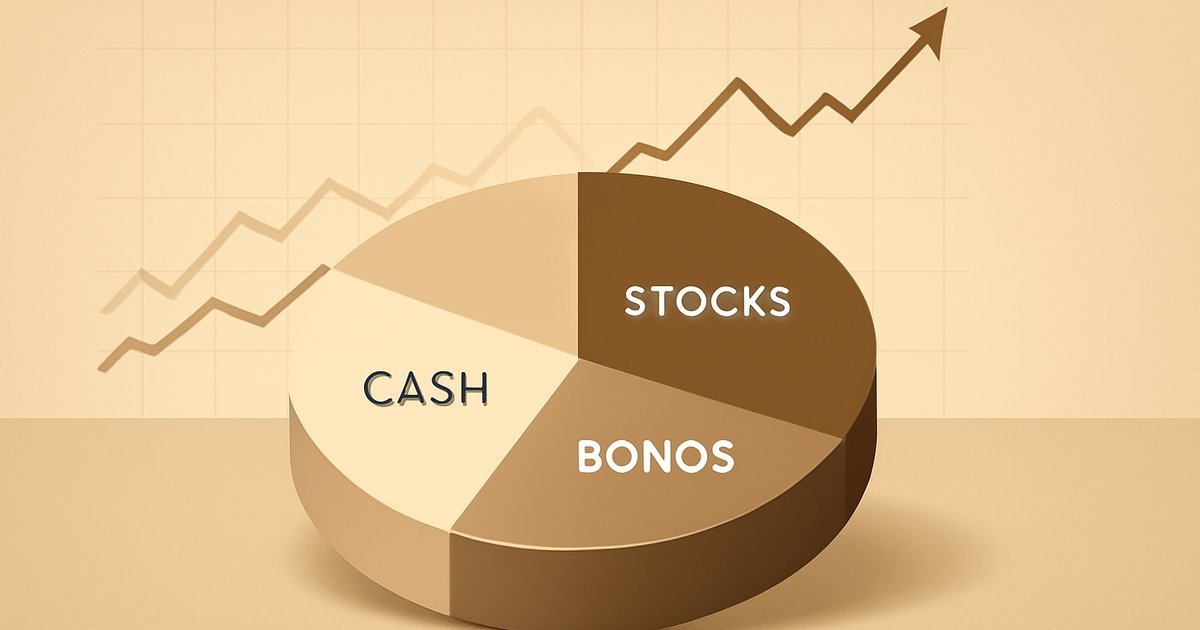
Asset allocation is the strategy of dividing your investment portfolio among different asset categories — primarily stocks, bonds, and cash — in proportions that match your financial goals, risk tolerance, and time horizon. It’s not glamorous. It won’t go viral on social media. But it’s the single most powerful lever you control as an investor.
In this guide, you’ll learn exactly how asset allocation works, how to build a strategy that fits your life, what common mistakes cost investors thousands of dollars, and how to adjust your mix as you age. Whether you’re 35 and just starting to build wealth or 58 and approaching retirement, this framework applies to you.
How Asset Allocation Works: The Core Mechanics
At its most basic level, asset allocation is about not putting all your eggs in one basket — but with a strategic rationale behind the basket choices, not just random diversification.
The three main asset classes behave differently under various market conditions:
- Stocks (equities): Higher long-term return potential, higher short-term volatility. The S&P 500 has delivered an average annual return of roughly 10% before inflation over the past century, according to data from Morningstar — but with years like 2008 (-37%) mixed in.
- Bonds (fixed income): Lower return potential but more stability. Bonds tend to cushion portfolios when stocks fall. U.S. Treasury bonds are backed by the federal government and carry minimal default risk.
- Cash and equivalents: Money market funds, CDs, and Treasury bills. Very low risk, very low return — but essential for liquidity and capital preservation.
Beyond these three, many portfolios also include real estate investment trusts (REITs), international stocks, and commodities as additional diversification layers.
The key insight: because these asset classes don’t move in perfect lockstep, combining them in the right proportions can reduce your overall portfolio risk without proportionally reducing your expected return. That’s the mathematical magic of diversification, formalized by Nobel laureate Harry Markowitz in his Modern Portfolio Theory.
The Federal Reserve’s 2025 Survey of Consumer Finances found that households with diversified investment portfolios accumulated significantly more wealth over 20-year periods than those concentrated in a single asset class — reinforcing what the academic research has shown for decades.
Key Benefits of a Disciplined Asset Allocation Strategy
Understanding why asset allocation works in practice — not just in theory — helps you stick with it when markets get turbulent.
1. It Manages Risk Without Eliminating Growth
A portfolio of 100% stocks maximizes long-term growth potential but can drop 40-50% in a severe bear market. For a 55-year-old with $600,000 saved, that’s a $240,000-$300,000 paper loss — terrifying enough to cause panic selling at exactly the wrong time. A 60/40 portfolio (60% stocks, 40% bonds) historically softened those drawdowns to roughly 20-25% while still generating solid long-term gains.
2. It Forces Disciplined Rebalancing
When you have a target allocation, market movements will drift your portfolio away from it over time. Rebalancing — selling what’s grown and buying what’s lagged — enforces the discipline of "buy low, sell high" systematically. According to Vanguard research, disciplined rebalancing can add roughly 0.35% in annual returns over time compared to an unmanaged portfolio.
3. It Aligns Your Portfolio With Your Real Life
A 32-year-old software engineer saving for retirement 30 years away has a completely different risk profile than a 61-year-old planning to retire in four years. Asset allocation gives you a framework to match your investment risk to your actual life circumstances — not just generic advice.
4. It Reduces Emotional Decision-Making
When you have a written asset allocation policy, market volatility becomes a trigger for systematic action (rebalancing) rather than panic. This is one of the most underrated benefits — the behavioral finance research from Dalbar consistently shows that the average investor significantly underperforms the market they’re invested in because of emotional timing decisions.
How to Build Your Asset Allocation Strategy: Step-by-Step
Building your allocation isn’t a one-size-fits-all exercise. Here’s how to approach it systematically:
Step 1: Define Your Time Horizon
How many years until you need the money? For retirement accounts, this is usually the distance to age 65-70. Money you’ll need in under 5 years should be in conservative allocations. Money you won’t touch for 20+ years can tolerate much more stock exposure.
Step 2: Assess Your Risk Tolerance — Honestly
Risk tolerance has two components: your financial ability to absorb losses (based on income, savings, and time horizon) and your emotional ability to sleep at night during a bear market. Ask yourself: "If my portfolio dropped 30% in 12 months, would I stay the course or sell?" Be brutally honest.
Step 3: Choose a Starting Allocation Model
These are widely used starting frameworks — not rigid prescriptions:
- Aggressive (80-100% stocks): Best for investors 35 and under with 25+ years to retirement and high risk tolerance.
- Moderate-Aggressive (70/30): Suitable for investors in their 40s with strong income and 20+ year horizons.
- Moderate (60/40): The classic balanced portfolio — appropriate for many investors in their 50s approaching retirement.
- Conservative (40/60 or 30/70): For investors within 5-10 years of retirement or those with lower risk tolerance at any age.
Step 4: Diversify Within Each Asset Class
Don’t just hold "stocks" — diversify within stocks by holding U.S. large-cap, U.S. small-cap, international developed markets, and emerging markets. Within bonds, consider a mix of short-term and intermediate-term Treasuries, investment-grade corporate bonds, and possibly TIPS (Treasury Inflation-Protected Securities) to hedge inflation.
Step 5: Implement With Low-Cost Index Funds or ETFs
For most investors, low-cost index funds and ETFs are the most efficient way to implement an asset allocation strategy. According to the ICI (Investment Company Institute), the average expense ratio for index funds has fallen to around 0.05-0.20%, compared to 0.60-1.00%+ for actively managed funds. Over 30 years, that fee difference can represent hundreds of thousands of dollars in your pocket.
For context on ETFs as a vehicle for this strategy, you may find it helpful to review Dollar-Cost Averaging: The Smart Way to Invest Consistently, which pairs naturally with an asset allocation plan.
Step 6: Schedule Annual Rebalancing
Set a calendar reminder once per year (or when any asset class drifts more than 5 percentage points from its target) to rebalance. Many 401(k) platforms offer automatic rebalancing — use it.
Costs, Fees, and Risks You Need to Understand
No investment strategy is free of costs or risks. Here’s what to watch for:
Expense Ratios and Fund Fees
Every fund charges an annual expense ratio. Even a 1% fee seems small but compounds dramatically — on a $500,000 portfolio, a 1% annual fee costs you $5,000 per year and potentially $150,000+ over 20 years compared to a 0.05% index fund. Always check the expense ratio before investing in any fund.
Tax Drag from Rebalancing in Taxable Accounts
Rebalancing in a taxable brokerage account can trigger capital gains taxes. The IRS taxes short-term capital gains (assets held under one year) as ordinary income — potentially up to 37% depending on your tax bracket. Long-term capital gains rates are more favorable (0%, 15%, or 20%). Strategy: prioritize rebalancing inside tax-advantaged accounts like your 401(k) or IRA first.
Sequence-of-Returns Risk
This is especially critical for investors near retirement. If the market crashes in the first few years of your retirement and you’re withdrawing funds, the combination of market losses and withdrawals can permanently impair your portfolio — even if markets eventually recover. A more conservative allocation as you approach retirement helps manage this risk.
Inflation Risk in Conservative Portfolios
Holding too much in bonds or cash carries its own risk: inflation erosion. With the CPI averaging around 2-3% historically (though higher in recent years), a portfolio yielding less than inflation loses purchasing power over time. This is why most financial planners recommend maintaining meaningful stock exposure even in retirement.
Common Asset Allocation Mistakes to Avoid
These errors are surprisingly common — and surprisingly costly:
Mistake 1: Setting It and Forgetting It Without Rebalancing
If you set a 70/30 allocation in 2019 and never rebalanced, the bull market likely pushed you to 85/15 or higher by 2022 — taking on far more risk than you intended, right before a volatile period. Rebalancing isn’t optional maintenance. It’s core to the strategy.
Mistake 2: Confusing Account-Level Allocation With Total Portfolio Allocation
Many investors look at each account — their 401(k), their Roth IRA, their taxable brokerage — in isolation. You need to look at your total asset allocation across all accounts. If your 401(k) is 80% stocks and your Roth IRA is also 80% stocks, you’re not as diversified as you think even if the accounts look different on paper.
Mistake 3: Letting Fear or Greed Override Your Written Plan
Selling stocks during a market crash and "waiting for things to stabilize" is one of the most expensive moves an investor can make. According to JP Morgan’s annual Guide to the Markets, missing just the 10 best trading days in the S&P 500 over a 20-year period cuts your total return nearly in half. Your written asset allocation plan is your defense against this impulse.
Mistake 4: Ignoring the Bond Side of the Portfolio
Many younger investors dismiss bonds entirely as "boring." While aggressive stock allocations make sense for long horizons, having zero bonds means your portfolio could drop 40-50% in a severe bear market with no cushion — potentially forcing you to sell equities at the worst time if you need cash.
Mistake 5: Not Adjusting Allocation as You Age
Your risk tolerance and time horizon change over time. A 60% stock allocation at 35 is quite aggressive; at 62 with retirement three years away, it may be dangerously so. Most financial planners recommend gradually shifting toward a more conservative allocation in the 10-15 years before retirement. Target-date funds do this automatically, which is part of their appeal for hands-off investors.
Alternatives to Consider
Asset allocation is a strategy, not a single product. Here are a few ways to implement it depending on your situation:
Target-Date Funds
Pros: Automatic, hands-off, built-in diversification and rebalancing. Glide path automatically becomes more conservative as you approach retirement. Low cost at major providers like Vanguard and Fidelity (expense ratios often 0.10-0.15%).
Cons: One-size-fits-all — doesn’t account for your specific risk tolerance, pension income, or other assets. Less tax-efficient in taxable accounts.
Best for: Investors who want set-it-and-forget-it simplicity, especially inside 401(k) accounts.
Robo-Advisors
Pros: Personalized risk questionnaire, automatic rebalancing, tax-loss harvesting (at many providers), low minimum investments. Annual fees typically 0.25-0.50%.
Cons: Less flexibility than self-directed investing. Fee adds up over time on large portfolios.
Best for: Investors who want automation with a bit more personalization than target-date funds offer.
DIY Three-Fund Portfolio
Pros: Maximum simplicity and low cost. A classic three-fund portfolio (U.S. total market index, international index, U.S. bond index) gives you broad diversification in just three holdings.
Cons: Requires you to manually rebalance and adjust allocation over time.
Best for: Cost-conscious, disciplined investors comfortable with a hands-on approach.
If you’re also thinking about how to grow wealth outside of your investment portfolio, you might explore Bond Ladder Strategy: How to Build Steady Income as a complementary income approach.
Frequently Asked Questions
What is the best asset allocation for someone in their 40s?
There’s no single "best" answer, but a common starting point for a 40-year-old with a 25-year retirement horizon is a 70/30 or 80/20 stock-to-bond split. Your specific income stability, pension benefits, risk tolerance, and other savings will all affect the right mix. Generally speaking, you still have enough time horizon to absorb stock market volatility while beginning to add some bond exposure for balance.
How often should I rebalance my portfolio?
Most financial planners recommend rebalancing annually or whenever an asset class drifts more than 5 percentage points from its target. Rebalancing more frequently than quarterly rarely adds value and can increase transaction costs and tax events in taxable accounts.
Can I use asset allocation inside my 401(k)?
Absolutely — and your 401(k) is often the best place to start because you can rebalance without triggering taxable events. Most 401(k) platforms offer automatic rebalancing options and a range of index funds across different asset classes. Review your fund lineup and build your target allocation using the lowest-cost options available.
What happens to my asset allocation when I retire?
In retirement, the general principle is to shift toward a more conservative allocation to protect against sequence-of-returns risk — the danger that a market crash early in retirement, combined with portfolio withdrawals, could permanently impair your savings. Many financial planners use the "bucket strategy," keeping 1-2 years of expenses in cash, 3-7 years in bonds, and the remainder in stocks for long-term growth.
Is a 60/40 portfolio still relevant today?
The 60/40 portfolio (60% stocks, 40% bonds) came under scrutiny in 2022 when both stocks and bonds fell simultaneously — an unusual correlation event. However, over longer periods, bonds still provide meaningful portfolio diversification. Many advisors now suggest variations like 60/30/10 (adding 10% alternatives such as REITs or commodities) to enhance diversification. The core principle of multi-asset diversification remains as relevant as ever.
Building Wealth Starts With Getting the Foundation Right
Asset allocation isn’t the exciting part of investing. It won’t generate dinner party conversation. But it is, according to decades of academic research and real-world data, the most important investment decision you’ll make.
Start by defining your time horizon and honestly assessing your risk tolerance. Choose an allocation model that reflects your actual situation — not just your best-case scenario. Implement it with low-cost index funds or ETFs. Rebalance annually. And adjust gradually as you age.
That’s the entire framework. Its power comes from consistency and discipline, not complexity.
If you’re also building out your broader financial plan, consider reviewing Dollar-Cost Averaging: The Smart Way to Invest Consistently — a strategy that pairs naturally with a sound asset allocation plan.
This article is for educational purposes only and does not constitute financial, tax, or investment advice. Always consult a licensed financial advisor, CPA, or attorney before making financial decisions.